Showing posts with label Theology. Show all posts

Wednesday, December 14, 2011

Planting theology...

I'm reading through the Letters of C.S. Lewis right now.  It has been a very rewarding read.  So many nuggets of thoughts buried in his letters.  Lewis wrote this,   
 So I lived a week...in one of those delightful vernal periods when doctrines which have hitherto been only buried seeds begin actually to come up - like snowdrops or crocuses.
and I felt a kinship.


Lewis, C.S. Letters of C.S. Lewis. Hardcourt, Brace and World, 1966.  W.H. Lewis, editor.  Page 194. 

Wednesday, November 9, 2011

Bonhoeffer on Pleasure

A quote from D. Bonhoeffer
"I am sure we ought to love God in our lives and in all the blessings he sends us. We should trust him in our lives, so that when our time comes, but not before, we may go to him in love and trust and joy. But, speaking frankly, to long for the transcendent when you are in your wife’s arms is, to put it mildly, a lack of taste, and it is certainly not what God expects of us.  
We ought to find God and love him in the blessings he sends us. If he pleases to grant us some overwhelming earthly bliss, we ought not to try and be more religious than God himself. For then we should spoil that bliss by our presumption and arrogance; we should be letting our religious fantasies run riot and refusing to be satisfied with what he gives. Once a man has found God in his earthly bliss and has thanked him for it, there will be plenty of opportunities for him to remind himself that these earthly pleasures are only transitory, and that it is good for him to accustom himself to the idea of eternity…. 
I am sure we honor God more if we gratefully accept the life he gives us with all its blessings, loving it and drinking it to the full, grieving deeply and sincerely when we have belittled or thrown away any of the precious things of life (some people grumble at such behavior and say it is bourgeois to be so weak and sensitive) than we do if we are insensitive towards the blessings of life, and therefore equally insensitive towards pain."
Dietrich Bonhoeffer, Letters and Papers from Prison

Wednesday, June 8, 2011

A deep breath of cool clear water (or something like that)

For several years now I have been attempting to understand how the culture I am immersed in (as an American, and with Western History in my particular past) has influenced me.  How has it shaped my understanding of reality and the truth about the world I live in?  It has been an exhausting investigation as I realize that I have been radically and fundamentally influenced by the last 400 years of culture currents.  In several senses, I have never had an original thought in my life, but have been fed every thought I have ever had by others, and I have been curious about who those others are, and what it was they were attempting when they passed on their thinking to subsequent generations.  In some ways, this whole endeavor has been unhealthy, causing a large dose of epistemological claustrophobia.  In other ways it has been a spreading of my horizons as I understand who I am better.

For example, try reading Alexis de Tocqueville's Democracy in America.  This book will alter your view of what it means to be an individual, and forces you to realize that you are only "individual" and "authentic" in roughly exactly the same way as everyone else in this American Democracy is "individual" and "authentic".  That book made me laugh out loud, it was so startlingly accurate about me and my neighbors.  And it was written by a Frenchman in the early 1800s!

So, for a couple of years now I have been trying to figure out how to respond to this strange, constricting realization I have come to: how deeply the philosophies around me (in particular, the branches and fruit and fruit pies coming from the philosophies of the "Enlightenment" (really, the Endarkenment) and Romanticism have been all I have ever partaken of, in some senses.  In fact, in a difficult and sometimes amusing way, I only ever assess the Enlightenment on its own terms...from an Enlightenment perspective.  Arrgh!  How to escape from this philosophical tail-chasing.

Along comes a couple of quotes in the last few weeks that have helped me take a really deep breath for the first time in a while.  One from Bonhoeffer by Eric Metaxas
To procrastinate and prevaricate simply because you are afraid of erring...seems to me almost to run counter to love.  To delay or fail to make decisions may be more sinful than to make wrong decisions out of faith and love.
In the middle of trying to carefully weave my way through decision-making, attempting to take into account all of the philosophies that are informing my thinking has been pretty crippling.  Here, Bonhoeffer reminds me that LOVE is the goal, and (I add) since I know I am probably not going to get it perfect, even if I reflect on a topic for decades...why not put love at the forefront, pray, think and then take action...then assess, and take more action...then assess again, etc.  I am trying to make that my new Mode of Operation.

THEN, along comes a few more thoughts, this time from Tim Keller's book, Gospel and Life.
A worldview is...the story of the world that operates at the root of a person's life.
And
We cannot help but participate in the worldview of our particular culture and generation.  But the gospel changes the way we look at everything.  We are to look at everything...and decide (a) what to keep as good, (b) what to reject as just too distorted, and (c) what to revise, rename, and reshape with the gospel. 
Very helpful thoughts for me.  I have realized for a while now that I can't "get out" of my own worldview, and that participating at some level in the worldview around me is impossible to escape.

Ken Myers suggests that we must make a decision.  Do we interact with that worldview in a mode of acceptance and adoption, or do we interact with it at some points in a mode of resistance and rejection.

Tim Keller's thoughts added to Ken Myer's help me to have a framework for thinking about these things.  And Bonhoeffer's helps to relieve the incapacitating pressure to think that I have to get it all logically and philosophically perfect before making decisions, and the Gospel itself, most importantly by far, has helped me to understand that it was for such an errant philosopher and sinner as myself that Jesus came to die, and restore me to right relationship with Himself.

Tuesday, April 19, 2011

He's got me thinking...

In a recent blog post, the pastor at the church we are currently "investigating" says this:
"There is NOTHING, nada, not one-single-thing, not one-single-action, no intention, no inclination or smallest glimmer of our most minute desire that recommends us to God.  I’ll even up the ante one further: I actually believe that the very BEST things we’ve ever done – the most pious, most religious, most holy, most selfless act of obedience, with the purest motives we could possibly muster on the best days, if rightly accounted for, would be in the debit column of our lives, NOT the credit column." 
Citation: Jean Larroux III, from KNOTS, his blog on the Southwood website

Sunday, April 17, 2011

Deliberate Living Recommended

Ken Myers, one of the most influential people in my life (via, primarily, his Mars Hill Audio Journal) says this about the focus of his work with the Journal:
"My work is really about producing thoughtful Christian faithfulness. If you start to think carefully about how you eat, how you spend time, how you think about place, all those things some people may think you’re trying to achieve salvation by works.  So my sense is that people with that kind of tendency, not just in the PCA, accept conventional ways of living from secular culture because they regard the effort to think thoughtfully and live deliberately as a kind of semi-Pelagianism.  And the idea that living deliberately is semi-Pelagian just baffles me.  Because when you don’t, you end up living in accordance with a very post-Christian, and in significant ways, anti-Christian culture."

Citation: Ken Myers, in interview with Walter Henegar

Saturday, April 16, 2011

Relationship Wreck

Peter Leithart makes these insightful (as usual) comments on the tweeks in what we mean by relationships:
"British sociologist Anthony Giddens has commented on the rise of what he calls “pure relationships.” A “pure relationship” is one in which “the relationship exists solely for whatever rewards that relationship as such can deliver.” A pure relationship has no external anchors or supports, but depends entirely on the commitment of the two who enter the relationship. 
Today, for example, we distinguish friendships from working relationships and family relations, thinking of a friend “specifically as someone with whom one has a relationship unprompted by anything other than the rewards that the relationship provides." 
In recent decades, marriage has increasingly come to be seen as a pure relationship, one that is “initiated for, and kept going for as long as it delivers emotional satisfaction." This is not, of course, how marriage was understood in earlier centuries: “Marriage was a contract, often initiate by parents or relatives rather than by the marital partners themselves,"  and in the Church, marriage was seen as having a “sacramental” character, even when it was not technically understood as a sacrament. 
The dangers go even deeper, however, since American Christians often regard their relationship with God on the model of “pure relationship.” When an Evangelical speaks of a “personal relationship with Jesus,” he’s not talking about a liturgically and catechetically formed relationship, surrounded by the supports of fellow believers, rituals, signs, and texts.  He’s talking about self-standing, free-floating, pure relationship, one made all the more unstable by the fact that one of the parties is not visible."

Citation: Leithart, Peter J. From the “Quodlibet” department in “Touchstone” magazine. June 2009. Page 5.

Saturday, April 9, 2011

Flight Control

A bumper sticker frequently seen on the cars of people who think they are being good witnesses for the Lord proclaim, “God is my copilot.” These well-meaning folk must be totally ignorant of the actual chain of command on commercial or military aircraft.  The copilot is second in command! 
At least, I hope they are merely ignorant of what a blasphemous sentiment they are broadcasting, and not just being more honest than the average professing Christian today.  For the whole tendency of our sinful nature, reinforced by every influence of our contemporary culture, is to resume command. We want to keep Christ as Savior; we want his help in our daily problems; but we want to fly the ship.  This demotion of Christ from captain to second officer happens subtly.  It is not always visible to other (at least if we don’t advertise it on our bumpers). But its effects are disastrously real. 
One of my greatest fears for American Christianity in our day as it flies along with God as its copilot is not that it won’t continue to grow in numbers, resources, and influence, but, but that it will-and God will look at us and say, “So what?” we had better turn the controls over to the Lord Jesus and become the copilots ourselves; otherwise, we may spend a lot of time congratulating ourselves on the comfort of the seats in the cabin and the speed at which we are able to move, only to discover at the Day of Judgment that we’ve just been flying around in circles.

Citation: Williams, Donald T. From the “Quodlibet” department in “Touchstone” magazine. September/October 2010. Page 4.

Monday, March 14, 2011

A look at baptism

"The church of today lives in an ethically debilitating climate.  Where did we go wrong? Was it the urbane self-centeredness of Peale's Power of Positive Thinking and its therapeutic successors? Was it the liberal, civic-club mentality of the heirs to the Social Gospel? Now we waver between TV triumphalism with its Madison Avenue values or live-and-let-live pluralism which urges open-mindedness as the supreme virtue.  And so a recent series of radio sermons on "the Protestant Hour" urged us to "Be Good to Yourself." This was followed by an even more innocuous series on 'Christianity as Conflict Management." Whatever the gospel means, we tell ourselves, it could not mean death.  Love, divine or human, could never exact something so costly.  After all, our culture is at least vestigially Christian and isn't that enough?
"(Christ's) message is not the simple one of (John) the Baptist, 'Be clean.'  Jesus' word is more painful - 'Be killed.'
"...We may come singing "Just as I Am," but we will not stay by being our same old selves.  The needs of the world are too great, the suffering and pain too extensive, the lures of the world too seductive for us to begin to change the world unless we are changed, unless conversion of life and morals becomes our pattern.  The status quo is too alluring.  It is the air we breathe, the food we eat, the six-thirty news, our institutions, theologies, and politics.  The only way we shall break its hold on us is to be transferred to another dominion, to be cut loose from our old certainties, to be thrust under the flood and then pulled forth fresh and new-born.  Baptism takes us there."
Christ, by His birth, life, death, resurrection and ascension has made a way for us to enter into the Kingdom of His Father.  Do we joyfully and gratefully, but from a distance, so to speak, accept His wonderful gift.

Paul seems to think we have joined Him there on the cross, and now are seated with Him in heavenly places.

Do we allow the truth of that to influence our thoughts about everything from our bank account to how we participate with and in all of the platforms for living that this world system has to offer?

I propose that because of the Good News that we have died, we must live as citizens of the Kingdom, and that means that in many ways we are "displaced persons."  In but not of the same nature.

How?  Not by simply being "good".  We can't be good enough to qualify for that recommendation.  But because we identify with Him who died and rose again.

Have you (if you are a Christian) ever thought about the oddity that what we have in common (communion) with other believers is the fact that our reliance is on the broken body and shed blood of the God/Man Jesus the Christ?

I don't know about you, but every once in a while, that strikes me as something quite amazing.

Citation:
Willimon, William. "Repent" in Bread and Wine: Readings for Lent and Easter. Orbis Books, Maryknoll, New York. 2011. Pages 6-7.

Saturday, February 19, 2011

More thoughts on Sabbath

Gracie and I have been becoming more thoughtful about the time that God has given us, and more attentive to opportunities for delight, rest, sharing, teaching, celebrating. (This is greatly a ramification of a lot of reflection on the liturgical year.)


For everything under the sun there is a season, and we are enriched as we reflect on God's gifts of times and seasons.  (Is this [taking a day of rest, or reflecting on Christ through the liturgical year] a "must-do"? Certainly not.  St. Paul is specific about that...we are in no way justified by reflecting in a certain way on days or a seasons, we are justified by the righteousness of Christ.  Just wanted to note that for posterity's sake, and because a friend asked me my thoughts on why we are taking a day of rest.)


Here is a thought about the nature of time that is quite beautiful, and I believe: true.  Remember the first and second commandments as you read this short passage.

Entering into Relational Rather Than Chronological Time 

We are all too familiar with chronology (chronos), the time we can measure and monitor. We note the passing of time in moments and events, hastening or lamenting time's movement. 

There is another kind of time talked about in the Bible, however: kairos. This is time experienced relationally, rather than sequentially. Kairos is time as an eternal moment, a divine appointment, a dynamic encounter. 

It recognizes that the fruitfulness of our life is more appropriately measured by the quality of our relationships than by the amount of activities we can cram into our moments. 

For six days we are often seduced into defining our worth by our works. The Sabbath reminds us that our worth is given to us by God. We belong to God, and by the Spirit of Christ we belong to one another. For Jewish families, the Sabbath is a day of feasting on good food and delighting in good relationships. Even the poorest family will scrimp and save so that the Sabbath meal will be the best of the week. Seated as guests at every Sabbath table will be strangers, aliens and those with no place to go. 

Therefore, the Sabbath is a day to enjoy intimate relationships.


Citation:
 Dearborn, Tim and Kerry (I think), "Recovering an Ancient Approach to Time Management in Our High-Tech Era". Copyright © 2001 University Communications, Seattle Pacific University. 
<http://www.spu.edu/depts/uc/response/winter2k1/sabbath.html> Accessed 11 February 2011.

Monday, February 7, 2011

Of the world, but not in it?

I'm afraid that (consciously or unconsciously) we are allowing the culture of this age to design the floor plan, build the foundation, construct the framing, and install all of the mechanical trades and fixtures in our thinking, and only then do we allow the Unadulterated Truth of Christ and His Word to choose the paint colors and hang a few pictures on the wall, and occasionally do a small repair or a tiny remodel.  I am concerned that this type of surface deep "Christianity" will not withstand when the pressures of life come.

The current divorce rate in the church; the rate at which student-age-church-goers are exiting the faith, never to return are both foils against which I filter this thought, and they leave me more concerned, not less.

We need to start considering how the culture we are inevitably, and even purposefully living in has informed our definitions of life, humanity, marriage, parenting, education, truth, entertainment, friendship...and whether the conclusions the culture has drawn, which we have accepted very deeply, harmonize with a deeply-rooted biblical view of the same topics.

An Example

The currently held definition of marriage, by those who are on the extremely conservative Christian side of our culture appears to me to be:

 "One man and one woman; in partnership; for mutual fulfillment and pleasure; a joint economic venture to cut costs of living; sexually fulfilling; children optional; pleasure non-optional; divorce frowned on but ultimately accepted without much ado besides surprise and chagrin and awkwardness on the part of others within the church."

There is, pragmatically speaking, a very slender, if any, difference between that definition of marriage and a union between two of the same gender.  All you have to do is replace a gender in the first clause of the marriage definition above, and the rest works perfectly.

Not so, a biblically grounded view of marriage.  Not even close.  In fact, you can not get from biblical marriage to same-sex union!  There is no road in between.

Biblical marriage is, for one thing, a demonstration of submission to God's rule and authority in the world to the fallen angels, thus a man by submitting to Christ as his head, and a woman by submitting to her husband acknowledges that Satan is wrong in his posturing lie that God's rules are hindering true fulfillment, (which was his primary lie in the garden and still today).  A woman, by submitting to her husband's authority says "No, Satan, you are wrong!  God is good, and you are not!"
How can a same-sex union do this?  It can not, by it's very nature!
A Biblical marriage is for submitting to the Lord as he allows the bearing of children.  Sex is not for pleasure primarily according to scripture.  Pleasure is a wonderful, fulfilling and important secondary consideration, but it is not its only or even its primary function.  We have allowed the culture to tell us differently, but the Scripture does not.  
How can a same-sex union accomplish this?  It can not, by it's very nature!
A Biblical marriage is an opportunity for a man to love a woman as the weaker vessel.
How can  a same-sex union accomplish this?  It can not, by it's very nature there is no weaker vessel to be honored.
I'm sure this will stir up controversy.  Stir away!


Citation:
Clark, David.  "Some of David's Thoughts on Culture and Living". David's Brain. Gurley, AL.  Accessed: 30 January, 2011.

Friday, February 4, 2011

Sanctified Pie

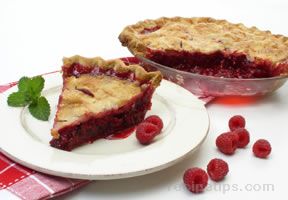
DAD’S RASPBERRY PIE
When I was a boy, my dad planted two long rows of raspberries next to our vegetable garden.  Each spring, slowly working with shears, he pruned out last years dry canes, so the young plants could grow unhindered.   He carefully packed the ground around each new cane with clean yellow straw, so the soil would remain cool and moist.  When the weather was dry, he trailed soaker hoses along each of the rows, providing just the right amount of water.  The result of his work and attention were two rows of abundantly fruitful raspberry canes.
One morning I watched out our kitchen window as Dad walked over the wooden foot-bridge that spanned our stream, and across the yard to the raspberry patch. He was carrying a cardboard quart basket and he started walking slowly down the row, carefully placing fully ripened raspberries in the basket.  He didn’t have to work his way far down the row before his container was full, and he carried it back across the bridge, and up the back steps of the house.
The door opened, and he walked in holding out his palm which held a few of the berries that were especially plump and juicy, “Look how big these raspberries are!” He offered them to Mom to sample, having taken his fill directly from the bushes.
After Dad left for work, my mother dusted her countertop with flour, rolled out her pie crust, carefully settling the delicate pastry down into her 8” Pyrex pie plate.  She ladled the rich red, slightly sweetened mash of raspberries into the pastry, and covered it with the top crust.  A few deliberate cuts in the middle of the crust, a dusting of white sugar, and then into the oven it went, to bake itself into fragrant perfection. 
About an hour later she pulled it out of the oven, and placed it on a cooling rack. The tender, crisp crust had wisps of aromatic steam puffing through the vents cut into it.  My eyes watered, and I started to salivate.
My dad taught mentally handicapped teenagers for several years, so on this particular day, he walked in the door about 4:30, and start sniffing. The air was rich with the aroma of the baked raspberry pastry.  He smiled, and kissed my mother.
“Woman, you are my kind of a wife!  I married you to make me pies!”  She smiled back at him, and patted him on his backside with a twinkle in her eye.

My brother burst in the door, “Hey dad!” then he smelled the pie.  “Oh wow!  Raspberry pie.  That smells great.”
Dad sliced himself a large wedge of the pie, placed it on a plate, and sat at the kitchen table with his back to our wood cook stove.
“David, get me a fork please.” I turned, picked a fork out of the silverware drawer, and handed it to him.
He poked the tines down into the tip of his piece, lifted a large forkful to his mouth and began to eat immediately, even though dinner was not far off. My brother and I would have gotten in big trouble for doing that! But Dad had his priorities, and he was “the Father in the house” which allowed him to break his own rules sometimes.
Savoring the bite, his eyes closed, he extolled my mother’s many virtues.  My brother and I stood around, hopeful that he would feel generous.
Finishing off the piece of pie, only small flakes of the crust left, he glanced at his crestfallen sons.  “Boys, let me tell you about sanctification.  We are told to be sanctified only for God’s use.  Do you know what that means?”
Shaking our heads, we waited.
“Well, to be sanctified is kind of like this raspberry pie.  Your mother makes many pies…apple pies, pumpkin pies, cream pies…and raspberry pies.  All of the other kinds of pies are common pies.  That means that just about anyone can eat them.  They are made for general consumption.  But her raspberry pies are sanctified pies.  They have been set apart and sanctified only for my use.  God has told us to be like this raspberry pie…we are not meant to be common, but holy, sanctified, set apart for His pleasure.  Every time you smell this pie, and see me eating my pie, you can remember to be sanctified to God.”
And that was that.  No pie for us.  Not even a bite.  My dad, normally a very generous man, had disappointed his boys, but now, decades later, that memory, soaked in the sights and smells of my childhood, has left its indelible mark on my life, as I try to be like that raspberry pie.


Citation:
Clark, David. "Sanctified Pie". David's "My Writing" Computer File. 
Accessed: 27 January 2011.

Tuesday, February 1, 2011

In My Infancy

O God of complexity
And nuance


O lover of commanding
The impossible


Of shrouding Truth
In mystery and simplicity


Bring peace to my startled heart
As you contemporarily reveal
My poverty


My poverty of generosity
And affection
Of understanding
And sight
Bring Peace to my startled heart


I had, in my infancy
(Moments ago)
Thought myself
Wise


Only to have that thought
Swept away
By the flood of
Your Son
The overwhelm of a glimpse past
My View


This epistemological disorientation
Exegetical dullness
Makes coherence impossible


And there You are again
Thanks be to God – You
My Generous, All-Knowing
Poetic
God


You are here, too
When I am
Lost


I can-
Wonderful Peace-
Find my home
In...
You


As I stumble
In this,
Your
Wilderness


You:
Home
Peace
Love
Infinite Applicator of Yourself
Heal
Call
Whisper
Impart


I accept the complexity
And
The nuance


As Long
As You are There

Citation:
Clark, David. David's Journal: Volume Nine. Gurley, Alabama: Dave's Journaling, 21 December 2010.

Wednesday, January 26, 2011

Peter Kreeft on Beauty

Peter Kreeft, in a speech on "Beauty", espoused a thought that I think David and Paul would have both agreed with*

(Since this came from a talk he gave, I did a little editing to smooth out some of his stream-of-consciousness style)
“A saint is a little Christ.  The connection between the beauty of the saints and the beauty of Christ is the connection between the original and the image. 
And one of the most powerful ways to become a saint is simply to see the beauty of God.
In heaven, we’ll all be saints.
People often ask the question, “Will we be able to sin in heaven?”
And the answer is obviously, “No”
And then their next question is, “Oh, well then God must take away our free will.”
“No.”
“Well if we have free will, we’ll be able to sin, because free will is always a choice”
And the answer is “Yes.”
“Well then, why won’t we?”
And the answer is “The Beauty of God.”
In the Beatific Vision, we will see the beauty of God so clearly, so overwhelmingly that it will be impossible to sin.
Why does anybody sin?  Why does the thief steal money? Because he sees that money can buy attractive things.  The dirty pieces of paper aren't attractive.  The dirty pieces of paper can buy things that satisfy his desires and are attractive to him.
He wouldn't steal cockroaches. He’d steal gold. 
But in heaven, we’ll see that sin is like the cockroach, because we’ll see that God is the real gold. So the vision of the beauty of God makes it impossible to sin.
The more we can get that (vision) here, the more close to sanctity we are. 
Religious art isn't just kicks. It’s not just aesthetics.
It’s a powerful aid to attaining the ultimate meaning of human life: to be a saint.
I love that line of Leon Bloy, 19th century French Catholic writer, 'In the end, there is only one tragedy, not to have been a saint.' And beauty is a very powerful aid to that.”
Peter Kreeft. Talk on "Beauty". Sacred Arts Foundation. 9/12/09. <http://www.peterkreeft.com/audio/38_beauty.htm>.
*Psa 27:4  One thing have I desired of the LORD, that will I seek after; that I may dwell in the house of the LORD all the days of my life, to behold the beauty of the LORD, and to enquire in his temple.(KJV)
*2Co 3:18  But we all, with open face beholding as in a glass the glory of the Lord, are changed into the same image from glory to glory, even as by the Spirit of the Lord.(KJV)

Friday, January 21, 2011

Touché

What would you have said if you were debating this Catholic theologian?  I would appreciate anyone's comments, if you have one.
"Several years ago, I was engaged in a public debate with a Protestant minister.  The event was held at a Protestant church before a mixed audience of Catholics and Protestants.  At one point in the debate, during the cross-examination section, my Protestant opponent posed this question to me:
"Can you give me one example of a tradition that's outside the Bible and is necessary for Christians?" He sat back with a smile, confident that I would not be able to answer his question.
"Yes, I can," I said.  "It's right here." At that I dropped my Bible on the table in front of him with a thump.
No one in the audience moved.
My opponent blinked, apparently unsure what to say in response.
I explained: "The Canon of the New Testament is a tradition, a Catholic tradition, that you as a Protestant follow." I continued, "the books that belong in the Bible, and in particular the New Testament are part of Tradition.  And you accept that Tradition and follow it, otherwise you would have no bible - you simply would have no way of knowing what the Bible is unless you accepted the Tradition of the canon."
This quote was found in a book I picked up at McKay's: Why Is That in Tradition? by Patrick Madrid.  It has been interesting reading.

Wednesday, January 19, 2011

A glimpse of the goodness of God

I am so grateful for every glimpse of the Gospel that I receive.  Here is one glimmering thought that sheds light for us. 
"...the God who saves us and the God who judges us is one God.  We are not, even, condemned by his severity and redeemed by his compassion; what judges us is what redeems us, the love of God.  What is it that will break our hearts on judgement day?  Is it not the vision, suddenly unrolled, of how he has loved the friends we have neglected, of how he has loved us, and we have not loved him in return; how when we came before his alter, he gave us himself, and we gave him half-penitence's, or resolutions too weak to commit our wills?  But while love thus judges us by being what it is, the same love redeems us by effecting what it does.  Love shares flesh and blood with us in this present world, that the eyes which look us through at last may find in us a better substance than our vanity..."
-From Love Came Down - Anglican Readings for Advent and Christmas

That thought reminds me of one of my favorite poems.  Scott Cairns, whose poem I found here, wrote this
Possible Answers to Prayer
"Your petitions—though they continue to bear   
just the one signature—have been duly recorded.   
Your anxieties—despite their constant,


relatively narrow scope and inadvertent   
entertainment value—nonetheless serve   
to bring your person vividly to mind.


Your repentance—all but obscured beneath   
a burgeoning, yellow fog of frankly more   
conspicuous resentment—is sufficient.


Your intermittent concern for the sick,   
the suffering, the needy poor is sometimes   
recognizable to me, if not to them.


Your angers, your zeal, your lipsmackingly   
righteous indignation toward the many   
whose habits and sympathies offend you—         


these must burn away before you’ll apprehend   
how near I am, with what fervor I adore
precisely these, the several who rouse your passions."

Tuesday, January 18, 2011

Thoughts on the family in relationship to the church

What is the relationship between the family and the local and universal church?  That question has been one of my constant companions as our family has grown and I have realized that I have a biblical mandate as a husband and father.

While browsing this rather wonderful Anglican family blog, I discovered The Domestic Church website.  Here are some interesting excerpts with thoughts on what it means to be a family within the context of the church:
"The Early Church described the family as the “domestic church.” This meant that it was not just a sociological unit. Rather, the family was created to play a specific role in God’s plan of salvation.
"Thus, the family is deeply associated with the Church in both its nature and structure. In the Old Testament, the family was so central that without it, there simply was no covenant. In the New Testament, the family reached its proper fulfillment in Christ. The family became the place where the Holy Spirit works out the salvation of each member and provided stability and structure for life’s journey.
"The baptized family is the first place where the essential teachings in catechesis, prayer, and morality are carried out to help in the conversion and development of growing Christians.
"Because the Christian family is the Church in miniature, it also shares the nature of Christ. It has a priestly, prophetic, and kingly dimension to it. The family offers Christ and intercedes for its own members and those around it (priestly); the family is a sign of Christ’s love and faithfulness to a world that is enmeshed in the culture of death (prophetic); and the family serves its own members and those around it sacrificially (kingly).
"By participating in the saving and redemptive nature of the Church, the family is profoundly rooted in the Church’s mission. The family has truly become a little church, or as it is better known, a domestic church."

Friday, January 7, 2011

What a title!

I recently was at McKay's Used Bookstore in Chattanooga, and ran across this title from an author I read regularly in Touchstone Magazine, Peter Leithart:
Against Christianity.

"Against Christianity"?  What an interesting title from a PCA ordained minister and senior fellow of theology and literature at New St. Andrew's College.  So, of course, and compulsively, I bought it.

It is not written in a typical manner.  It is comprised of 5 chapters
  1. Against Christianity
  2. Against Theology
  3. Against Sacraments
  4. Against Ethics
  5. For Constantine
And you know that he is being provocative with a chapter titled "For Constantine".  Those chapter titles just make me smile, because I know this is going to be interesting.  And it is.  Not only are the titles interesting, but the layout of the chapters is.  Not so much a running script, as short, choppy snippets of thoughts: sometimes a sentence, sometimes several paragraphs.

From the Preface
"This book is theological bricolage and lurches at many points toward a form of theological haiku.  I have come to think, however that this is all for the good, for the effect I hope for is the effect of haiku.  At its best, haiku glances at the familiar from an awkward angle; it presents what we normally approach straight-on from the side or underneath or inside out and helps us to see it, in a flash, as something wholly new."
And from Chapter 1
"Christianity is biblical religion disemboweled and emasculated by (voluntary) intellectualization and/or privatization.
"Christianity is not merely a haphazard embrace of the values and practices of the modern world. Worldliness in that sense has plagued the Church since Corinth and will be a temptation to the end of time.  Christianity is institutionalized worldliness, worldliness accepted in principle, worldliness not at the margins but at the center, worldliness built into the foundation.
"Christianity is worldliness that has become so much our second nature that we call it piety."
Well, he is obviously being intentionally provocative. It reminds me of the title that some of my friends have been reading lately, "Pagan Christianity", though obviously it won't follow the same lines with a chapter entitled "For Constantine".  Or maybe it will, from an oblique angle.

But!  I am not going to read this right now...I'm reading "Third Ways"!  I only picked it up to skim it!

By the way, here is a haiku I just picked up by googling "haiku" in order to understand what PL was alluding to in his preface.

the morning paper
harbinger of good and ill
--I step over it

-by Dave McCroskey

Thursday, January 6, 2011

An Anglican's Response

Those that have been keeping tabs on me for a while will know that I have been considering the Anglican Church as a possible way of expressing my faith and worship. I first started considering this as an option when I discovered how many of the authors that influence my thinking are Anglican.  (C.S. Lewis, Os Guinness, Jeremy Begbie, J.B. Phillips, G.K. Chesterton-who was Catholic, nee Anglican, Alan Jacobs, and probably most importantly Ken Myers.)  


These are all men who, as authors and thinkers, I deeply admire, and whose thoughts I ponder.  As I realized that Anglicanism was a common thread, I decided to explore for myself.  


In the middle of that, I happened upon Alan Jacobs e-mail address.  His blog, which I follow, was having a comments issue, so he posted his e-mail address in order to rectify the problem.  I took that opportunity to write to him with a question, "Why are you Anglican?" (a question which I introduced a little less abruptly in the e-mail.)


A.J., the "Clyde S. Kilby Chair Professor of English" at Wheaton, was polite enough to respond, and here is a part of his e-mail, which was a copy and paste of something he wrote for his church's website:


"We are heirs of CATHOLIC tradition: we draw for our sustenance upon
teaching and practices that go back to the Apostles but flowered fully
in the Church's first several centuries. The foundation laid for us,
and for all subsequent generations of thoughtful Christians, by the
Early Church Fathers is a rich legacy. From those early times we
inherit our Creed, our sacramental worship, and our sacramental
theology; these we share with Christ's true Church wherever it may be
found. We see that kinship in powerful ways when we look upon our
brothers and sisters in the Roman Catholic Church and in the Orthodox
world. In that sense we claim, and rejoice in, catholicity.

"But we also acknowledge that that Church has not always faithfully
preserved its theological and spiritual inheritance, and that, in His
love and care, in the sixteenth century God raised up great men of
faith to REFORM the church, to call us back to the Bible as the
ever-living Word of God, the reliable testimony to his grace and favor
towards us in the life, death, and resurrection of His Son. In that
Word we see clearly that we are saved by God's boundless grace, and we
appropriate that grace through faith in Jesus Christ. It is this
message -- which we share with all the churches that trace their
lineage to the Reformation -- that we proclaim in our preaching and
enact in our worship.

"We strive to be a church that is fully catholic and fully reformed;
and this is what we think it means to be ANGLICANS."


This short essay was particularly interesting because I had recently decided to stop acting as if history didn't exist as I pursued loving God and loving others.